The shock was real.
The guilt was heavy.
But the truth is this: MaryAnn was not negligent. She was uninformed—too late.
MaryAnn’s story reflects a wider issue affecting many families:
Limited early education on oral health
Misconceptions about baby teeth (“they will fall out anyway”)
Daily habits that unknowingly harm children
Lack of structured guidance from early childcare systems
This is not a parenting failure.
It is a system gap in early childhood support and education.
In my home childcare environment, similar patterns appeared repeatedly:
Bottles filled with sugary drinks
Frequent sugary snacks
Irregular or unsupervised brushing
Children with little understanding of hygiene routines
These were not isolated cases—they were common practice.
And that is where NFF intervention thinking begins:
When a pattern is common, it is no longer individual—it is systemic.
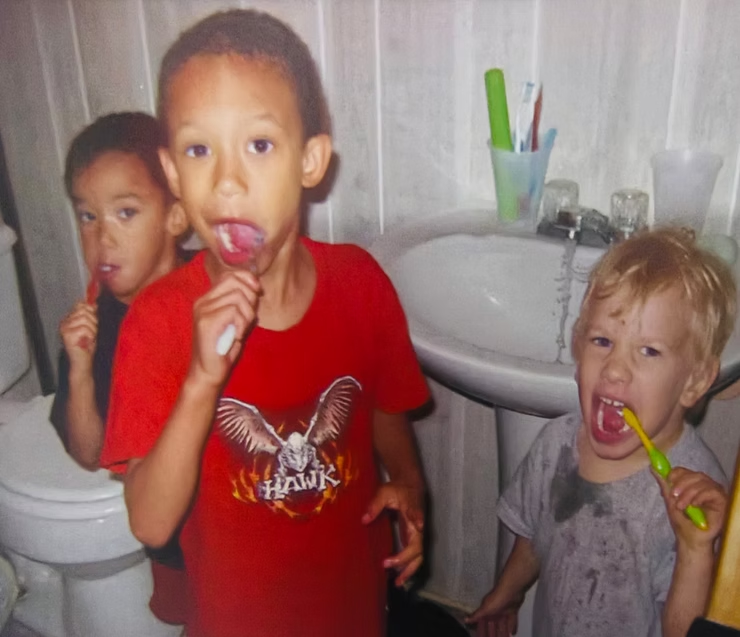
Instead of waiting for problems to surface, we introduced structured daily oral care routines within the childcare setting:
Supervised toothbrushing after meals
Age-appropriate guidance on brushing techniques
Teaching children why oral care matters
Continuous engagement with parents on daily habits
This was not just a hygiene activity.It was behavior formation through guided practice.
Children became more consistent in brushing
Awareness improved among parents
Hygiene became part of daily routine—not an afterthought
Preventive care replaced reactive care
This demonstrates a key NFF principle:
When guidance is practical and consistent, behavior changes.
Oral health is often treated as a personal responsibility—but children do not operate independently.
Their wellbeing is shaped by a network:
Parents
Caregivers and educators
Health professionals
Community systems
When this network is disconnected, children fall through the gaps.
MaryAnn’s story is not isolated.
It represents what happens when support systems are not aligned.
To prevent similar outcomes, we must shift from awareness to structured action:
Introduce oral health guidance in early childcare programs
Equip parents with simple, practical knowledge early
Make oral care part of school/daycare routines
Reinforce consistency at home
Ongoing communication—not one-time advice
Shared responsibility in habit formation
Engage dental professionals in early education
Create accessible outreach programs
We cannot wait for pain to teach us.
We cannot wait for damage to act.
Because by then, intervention becomes costly—emotionally and financially.
NFF stands for early guidance, practical action, and shared responsibility.
Healthy smiles are not created by chance.
They are built through informed families, supportive systems, and communities that take responsibility together.
Takeaways: Every child deserves that foundation-someone to speak on behalf of healthcare, health growth, learning, and development.
Share your own parenting experience or explore our programs designed to support families.
Share Your Story Our Programs